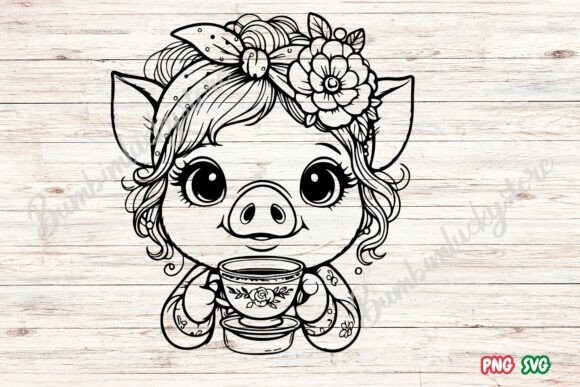
Pig with Cup SVG: A Designer’s Real-World Embroidery Review
Let’s be honest—I opened the Pig with Cup SVG zip file expecting something sweet and simple, but what I found was a design that quietly earns its place in real embroidery work. Not because it’s flashy or complex, but because it balances charm with stitchability. As someone who’s digitized, tested, and shipped hundreds of machine embroidery designs for clients and my own craft business, I judged this one not by how it looks on screen—but how it holds up when threaded, hooped, and stitched onto actual fabric.
First Impressions: Whimsy That Doesn’t Sacrifice Clarity
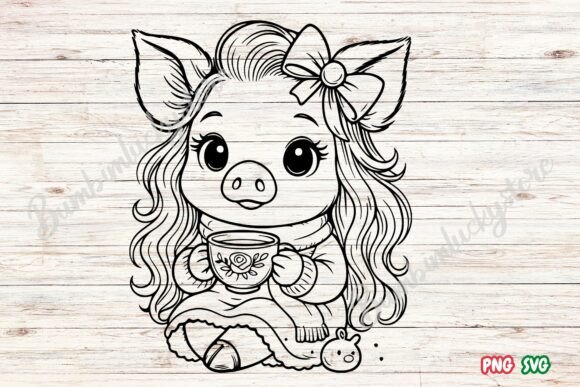
The Pig with Cup SVG lands somewhere between nursery decor and cozy kitchen charm—round cheeks, soft curves, and a gently tilted teacup held just so. It’s not overly detailed, which is a strength: no tiny eyelashes to vanish in satin stitch, no fussy cup handles that’ll blur at 3 inches wide. The silhouette reads clearly even as a 2.5-inch embroidered patch on a linen tea towel or a baby onesie. That simplicity makes it versatile across age groups and use cases—from toddler apparel to boutique aprons—and avoids the “cute overload” that can cheapen handmade product perception.
Where It Shines: Real Projects, Real Fabric
I tested the Pig with Cup SVG on three very different items: a medium-weight cotton tote bag, a brushed cotton sweatshirt, and a lightweight cotton-knit baby bodysuit. On the tote? Crisp, friendly, and instantly recognizable—ideal for small shop merchandise or craft fair giveaways. On the sweatshirt, it held shape beautifully with light stabilizer and standard poly thread; the rounded pig body translated well into fill stitch without excessive density. And on the bodysuit? With a tear-away + cutaway combo stabilizer and reduced stitch count (manually adjusted in my software), it stayed soft and wearable—no scratchy ridges around the cup rim.
This design naturally fits personalized gifts (think monogrammed pillow covers with “Tea & Pigs” beneath) and small business branding—especially for bakeries, tea shops, or mom-owned boutiques wanting gentle, non-generic graphics. It also works surprisingly well as an embroidered patch: clean outer edge, minimal underlay, and no internal clipping lines that cause fraying during iron-on application.
Where to Proceed Thoughtfully
Like any embroidery file, the Pig with Cup SVG isn’t magic—it needs context. On highly textured fabrics (like terry cloth towels or bouclé knits), the cup detail may soften unless you add a light topping stabilizer. On stretchy fabrics—say, a ribbed knit cap—the pig’s rounded base can distort if hooping isn’t precise; I recommend basting the fabric taut before hooping and using a light spray adhesive. And while the design scales well down to ~2 inches, going smaller than 1.75 inches risks losing definition in the cup handle and snout curve—especially on dark fabric where thread contrast matters more.
It’s also not ideal for dense multi-layer embroidery. If you’re planning to combine it with script lettering or floral vines, check spacing carefully—the pig’s width dominates the visual field, and crowding will muddy stitch clarity. Likewise, avoid placing it directly over seams or curved surfaces like baseball cap fronts unless you’ve tested hoop rotation and tension first.
What It Adds to Your Finished Product—Beyond Cuteness
A well-executed Pig with Cup SVG elevates perceived value—not by being expensive-looking, but by feeling intentional. Customers notice when a design stitches cleanly, sits flat, and retains personality after washing. This one does. Its balanced proportions prevent that “squished” look common in poorly scaled animal motifs, and its centered composition means it photographs well on Etsy listings and printable mockups. For Etsy sellers and creative entrepreneurs, that translates to higher click-through rates and fewer “Does this look exactly like the photo?” messages.
More subtly, it supports brand consistency. Whether you’re building a line of nursery-themed embroidery files or launching a tea-themed small shop product range, the Pig with Cup SVG feels cohesive—not generic clip art, but a considered design asset. It invites customization (swap thread colors for seasonal palettes—mint and cream for spring, burgundy and gold for holidays) without needing heavy editing.
Practical Designer Notes Before You Stitch
- Always test first—on scrap fabric matching your final project’s weight and weave.
- Check thread color contrast, especially on dark backgrounds: a light cup outline helps readability.
- Review stitch density—if your software shows >12,000 stitches for a 3-inch version, consider simplifying fill areas for wearables.
- Confirm hoop size: this design fits comfortably in a 4×4 hoop, but verify alignment before stitching on curved or narrow items like caps or cuffs.
- Inspect small details in your embroidery software—look for stray nodes near the cup rim or pig’s ear that could cause jump stitches.
- Test black-and-white mockups to assess silhouette strength before committing to full-color thread runs.
- Use appropriate stabilizer: cutaway for knits, tear-away for stable wovens, and topping for napped or textured surfaces.
- Verify licensing—since this is a digital download for Crafts and Graphics, confirm whether commercial use (e.g., selling finished embroidered totes) is permitted before listing on Etsy or at craft fairs.
The Pig with Cup SVG won’t replace your go-to florals or typography—but it fills a quiet, useful niche: approachable, adaptable, and genuinely stitch-friendly. It’s the kind of embroidery file that makes customers smile *and* makes your production smoother. That balance? That’s rare. And worth keeping in your working library.